Methodology
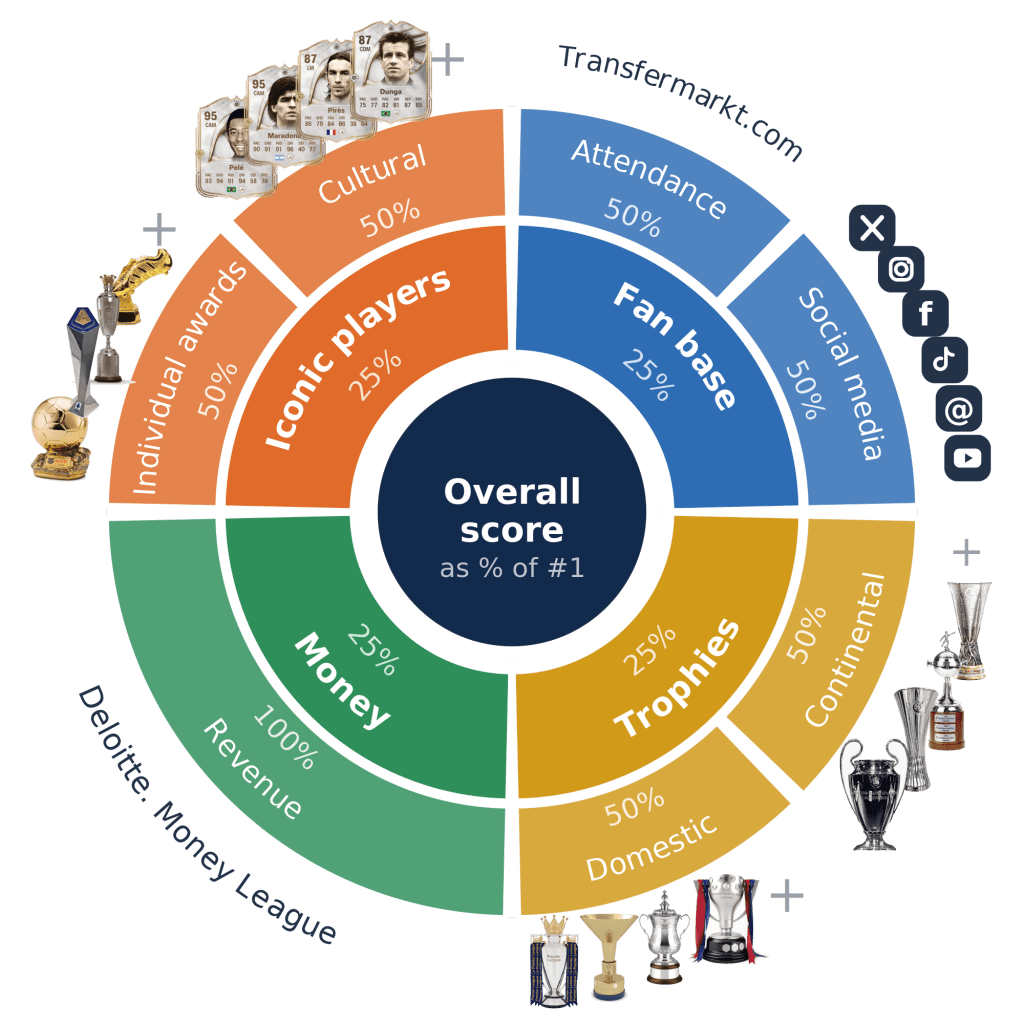
4 ranking criteria, equally weighted: 1. Fan base, 2. Trophies, 3. Financial, 4. Iconic players.
Each run on a percentage of #1 club in that category.
Simplicity preferred to complex formulas.
Raw data supplemented with estimates.
No era normalisation i.e. seasons valued equally, and recent seasons not weighted higher.
Ranking criteria
Attendance - 50% of the Fan Base score
Average home league attendance per season from 1980–81 to 2024–25 (45 seasons), expressed as a percentage of the #1 club in each season and then averaged across seasons. Each season is weighted equally - so no recency bias. The COVID seasons (2019/20, 2020/21, 2021/22) are discounted.
Data sources for attendance
Transfermarkt is the single authoritative source covering roughly 75% of all info, and naturally this has strong coverage of the big clubs. The remaining ~25% are filled using, in order of preference: (1) linear interpolation between adjacent known years; (2) league-trend × club-scale modelling; (3) external-knowledge baselines where verified data is sparse (e.g. pre-1989 Argentina during the hyperinflation crisis); (4) single-club-country direct baselines (Georgia, Slovakia, Ecuador, where the club essentially is the league); (5) specific historical overrides for known facts - for example, Aberdeen 1982–83 = 19,500 as Cup Winners' Cup winners under Ferguson; a +18% continental-trophy boost in CL or Libertadores winning years, +12% afterglow the following season, +5–10% for finalists, +10% for Europa / Sudamericana / CAF / AFC CL winners; stadium-renovation adjustments (e.g. Maracanã 2010–12 reducing Flamengo and Fluminense attendances by ~35%); and war / political-shock adjustments (Croatian War 1991–95, Yugoslav UN sanctions 1992–95, Argentine 1989–91 hyperinflation, NASL collapse 1984 affecting US clubs).
Social media - 50% of the Fan Base score
Total followers across YouTube, Instagram, Facebook, X and TikTok, summed across all official club accounts starting from 2023. As with Attendance, values expressed as a percentage of the #1 club in each season and then averaged across seasons, with each season weighted equally.
Data sources for social media
CIES for the top c.100 clubs, and then individually sourced for each of the smaller clubs directly from the 5 social media platforms.
Continental trophies: 50% of the trophy score.
POINTS ALLOCATION:
- 15 points for winning the top continental cup (Champions League / Copa Libertadores / AFC Champions League / CAF Champions League / OFC Champions League / CONCACAF Champions Cup).
- 5 points for the second-tier continental cup (Europa League / Copa Sudamericana / equivalent).
- 2 points for the third-tier (UEFA Conference League / equivalent).
- 25% of points allocated to losing finalists.
- European Super Cups do not count.
MULTIPLIERS:
(1) CONTINENTAL STRENGTH MULTIPLIER - how well each federation does at the World Cup and Club World Cup, with a smoothing function (SQRT) so the gap between strong and weak federations isn't extreme. In practice: UEFA = 1.0, CONMEBOL ≈ 0.80, and other federations sit lower. The exact weighting points are: World Cup win 20, runner-up 10, third-placed 4, fourth-placed 2 points; Club World Cup (and equivalents) are 25% of these.
Domestic trophies: the other 50% of the trophy score.
THE HEADLINE IDEA is simple: points for league titles + points for cup wins, but with three multipliers afterwards to make sure a Serbian title isn't valued the same as a Spanish one.
POINTS ALLOCATION:
(A) LEAGUE POINTS - 2 points per top-flight league title won.
- In countries where two league championships are awarded each year (Mexico's Apertura/Clausura, plus Argentina, Colombia, Chile, Paraguay), each half-season title counts as 0.5. Older long-season titles from those same countries - won before the league split into two short tournaments - still count as the full 1.0.
(B) CUP POINTS - every season offers exactly 1 point of cup credit.
- In countries with only one cup, the cup winner gets the full 1.0 that season.
- In countries with both a primary and a secondary cup, the primary cup winner gets 2/3 of a point and the secondary cup winner gets 1/3. The 6 countries this applies to are: England (FA Cup + League Cup since 1960), France (Coupe de France + Coupe de la Ligue, 1994-2020 only), Scotland (Scottish Cup + League Cup since 1946), Portugal (Taça de Portugal + Taça da Liga since 2007), Germany (DFB-Pokal + DFL-Ligapokal, 1972 one-off plus 1997-2007), and Spain (Copa del Rey + Copa de la Liga, 1982-1986 only). For every other country and for the years either cup didn't exist, it reverts to the 1.0-to-the-winner rule.
- One-off curtain-raiser super-cups (Community Shield, Trophée des Champions, Supercoppa Italiana, Johan Cruyff Schaal, etc.) don't count.
MULTIPLIERS:
(1) LEAGUE STRENGTH MULTIPLIER - how good the country's clubs are in continental tournaments, with a smoothing function. Spain = 1.0 (top), England ≈ 0.88, Italy ≈ 0.79, Germany ≈ 0.64, all the way down to small leagues at ≈ 0.10. Translation: winning La Liga is worth a lot more than winning the Croatian league.
(2) CONTINENTAL STRENGTH MULTIPLIER - same coefficient as the continental trophies section above, but where FIFA World Cup and FIFA Club World Cup / Intercontinental Cups are considered. UEFA = 1.0 (top), CONEMBOL (South America) ≈ 0.8, CAF (Africa) ≈ 0.14, CONCACAF (North America) ≈ 0.12, AFC (Asia) ≈ 0.12, OFC (Oceania) ≈ 0.04.
(3) LEAGUE INTENSITY MULTIPLIER - designed to stop dominated leagues like Scotland (where Celtic + Rangers have won almost everything) or Germany (Bayern Munich) from running away with the score. Calculated using the Herfindahl-Hirschman Index (HHI and SQRT) - the standard concentration measure used in economics and antitrust analysis to gauge how dominated a market is by its largest players. So in a wide-open league (e.g. England) this is 1.0, while in Scotland it's ≈ 0.45, and Germany it's ≈ 0.74.
Average revenue per season from 1997–98 to the present
Expressed as a percentage of the world's highest-revenue club in each season, then averaged across seasons. All figures are in EUR millions, converted from the club's local reporting currency at year-specific average exchange rates.
Data sources for Revenue
Primary sources - the spine of the data. Deloitte Football Money League (published every February since 1998), audited annual accounts, and league-specific reports such as the Sports Value annual reports for Brazil. The coverage for the big teams is pretty good: Top 20 clubs ~ 90% coverage from confirmed sources; Top 50 clubs ~ 70%; and even the Top 100 is more than 50%. So its mainly the smaller clubs where we needed to add in estimates.
Estimation methods, for gaps in the published data:
1. Log-linear interpolation - the primary method and pretty solid. Between two known revenue figures, assume compound growth between them.
2. Single-anchor extrapolation - for smaller clubs with only a handful of published data points, calibrated against league trend, attendance and league positioning.
3. Event-driven adjustments - applied where a specific event materially affected revenue (promotion or relegation, Champions League runs, club takeovers, financial crises producing revenue cliffs).
4. Currency-crisis adjustments - applied where local-currency reporting in a crisis year would otherwise wildly distort the EUR figure.
Player awards (50% of Iconic Players pillar)
The club a player was at WHEN they won an award gets the points. Other clubs they play / played for get a pro-rata split of up to 50% of these points (earning 10% per season and capped at 50% (5 seasons), with anything unearned kept by the award-winning club).
Awards counted:
1. MAJOR TOURNAMENTS (FIFA World Cup + 6 Continental Confederation championships - Euros, Copa America, AFCON, Asian Cup, Gold Cup, Nations Cup):
- 15 points: Player of the Tournament
- 5 points: Top Scorer
- 5 points: Winning Captain
Multipliers: (i) full weight for World Cup, half for continental; (ii) continental strength weighting (e.g. Euro 1.0 vs Copa America 0.8); (iii) frequency weighting (every-4-year tournaments get full credit; more frequent ones less)
2. PLAYER OF THE YEAR AWARDS:
- 3 / 2 / 1 points for top three placings
- Awards covered: Ballon d'Or family (Ballon d'Or, FIFA World POTY, FIFA Ballon d'Or, The Best FIFA Men's Player); 6 continental POTYs (CAF, CONMEBOL El Mundo + El País, CONCACAF, AFC, Oceania); and the top 24 domestic leagues' POTY equivalents (PFA / FWA, La Liga LPF, Serie A Footballer of the Year + Guerin d'Oro, Bundesliga Kicker etc), plus four historical/defunct competitions to capture earlier eras: the Soviet, Yugoslav, Czechoslovak and NASL (USA) Footballer of the Year
- Multipliers: (i) Global = 1.0, Continental = 0.5, Top-league = 0.5; (ii) continental strength as above; (iii) league strength as above; (iv) ABROAD multiplier = 0 if the player wins a league POTY/Top Scorer but plays for a club outside that league (avoids inflating nationality-eligibility awards).
3. TOP SCORER AWARDS:
- 1 point each for league top scorer in the top 12 leagues
- Same multipliers as Player of the Year
4. FIFA HALL OF FAME INDUCTEE: 15 points (used as a proxy for legends from before formal awards existed for them — e.g. pre-1956 Europeans, pre-1971 South Americans)
5. WORLD RECORD TRANSFER FEE: 3 points to the buying club only
150% FALLBACK: if a player has no other historic clubs in our database, such as a Maldini at AC Milan or a Totti at Roma, the award club receives 150% of the points (so no points leak away).
Cultural icons (50% of Iconic Players pillar).
A separate ranking that captures how culturally iconic a player is, recognising that great players aren't always those with the most trophies (Beckham, Ginola, Totti etc.). Based on EA Sports FC 26 game (Hero and Icon cards).
1. PLAYER POINT POOL: each player has a points pool of (OVR − 84) × type multiplier
- Icon card = 1.0× multiplier; Hero card = 0.75× multiplier
- Example: Iniesta (Icon, OVR 92) = 12 points; Eden Hazard (Hero, OVR 88) = 6 points
- The OVR-84 floor accounts for all Icon or Hero players being a minimum of OVR-85 and so emphasises the degree of separation between great players and truly iconic players
2. PLAYER POOL: 224 EA-included Icon and Hero players, supplemented with 91 further entries (a ~40% top-up), in two groups:
- Active players (27) added on EA Team-of-the-Year (TOTY) logic, counting appearances across all 18 EA editions (FIFA 09 in 2009 through EA FC 26 in 2026): 3+ TOTY appearances = Icon-equivalent (Mbappé, Messi, De Bruyne, CR7, Sergio Ramos, Modrić, Kanté, Bellingham, Dani Alves, Piqué, Van Dijk, Neymar); 2 TOTY appearances = Hero-equivalent (Neuer, Lewandowski, Donnarumma, Hakimi, Dias, Theo, Rodri, Haaland, Kane, Suárez, Bonucci, Mané, Benzema, Salah, Trent Alexander-Arnold).
- Manual additions (64) correcting for:
(i) Recency bias - pre-1985 greats EA has never carded (José Leandro Andrade, Obdulio Varela, Tostão, Sandro Mazzola, Sepp Maier, Johan Neeskens, Ruud Krol, Giuseppe Meazza, Sándor Kocsis, Nándor Hidegkuti, etc.), plus a few modern icons EA omits (Platini, Agüero, Robben, Cavani, Paolo Rossi).
(ii) South American / African / Eastern European under-representation - South Americans (Varela, Andrade, Ghiggia, Heleno, plus newly added Elías Figueroa, Alberto Spencer, Teófilo Cubillas, José Luis Chilavert), Africans (Salif Keita, El-Khatib, Roger Milla, Ben Barek, plus Rabah Madjer), and Eastern Europeans (Streltsov, Džajić, Bican, Belanov, plus Zbigniew Boniek).
3. CLUB ALLOCATION by tier:
- 'Iconic Tier' slots (up to 3): clubs where the player had their defining iconic period (e.g. Cruyff = Ajax + Barcelona). Weight 3 each.
- 'Other Iconic' slots (up to 3): clubs where the player was also iconic but to a lesser degree (e.g. Cruyff = Feyenoord). Weight 1 each.
- Non-iconic residual: ALL other clubs the player played at (e.g. Cruyff = Washington Diplomats and Los Angeles Aztecs) allocated pro-rata based on seasons played (with a max 10% CAP). Combined weight 0.5, split among them by seasons played.
- Each club's allocation = (its weight / total weight) × player's points
Time periods covered
Attendance: All 49 leagues from 1980/81 to 2004/25 (45 seasons).
Social media: All 5 platforms from 2023 to June 2026 (4 seasons).
Continental :
UEFA: Champions League equivalents 1955 onwards, Europa League equivalents 1955 onwards, European Conference League 2021 onwards
CONMEBOL: Libertadores 1960 onwards, Copa CONMEBOL Cup equivalents 1988 onwards
CAF: African Cup of Champions Clubs 1964 onwards, CAF Confederation Cup equivalents 1975 onwards
AFC: AFC Champions League equivalents 1967 onwards, AFC Cup equivalents 1990 onwards
OFC: OFC Champions League equivalents 1987 onwards
Domestic: 1897 onwards through to the end of the 2025/26 season and the end of the 2025 season for the relevant Southern Hemisphere leagues.
Revenues: 1997 onwards
Player Awards
World Cup: 1930 onwards
Ballon d'Or: 1956 - 1994
FIFA World Player of the Year: 1995-2010
FIFA Ballon D'Or: 2010 onwards
El Mundo : 1971-1985
El Pais : 1986-2006 (1995-2006 50% weighting as South American players now eligible for Ballon D'Or)
FIFA Hall of Fame: Covering European players pre 1956 Ballon D'Or awards and South American players pre 1971 El Mundo awards
League POTY + Top Scorer: Top 12 leagues (England PFA/FWA, Spain LPF, Italy Serie A Footballer + Guerin d'Oro, Germany Kicker, France UNFP, Portugal CNID + Bola de Ouro, Netherlands Gouden Schoen, Argentina Olimpia de Plata, Brazil Bola de Ouro, Mexico Liga MX POTY, Saudi Pro League POTY, plus Pichichi/Capocannoniere/Bundesliga Torschützenkönig/Brasileirão Top Scorer/Eredivisie Top Scorer etc.). Coverage typically 1970s onwards (varies by league/award).
Continental POTYs: African Footballer of the Year (France Football 1970-1994, CAF 1992 onwards); CONMEBOL South American POTY (El Mundo 1971-1985, El País 1986 onwards); CONCACAF Men's POTY (2013 onwards); AFC Asian Player of the Year (1988 onwards); Oceanian Footballer of the Year (1988 onwards)
Cultural icons
Snapshot of EA Sports FC 26 Hero + Icon cards (Sept 2025 release). Annual EA Team of the Year (TOTY) coverage spans all 18 editions: FIFA 09 (Jan 2009) through EA FC 26 (Jan 2026). Manually-added greats span from 1920s legends to players retiring 2024.